
In 2025, global retail sales grew by just 2% in real terms, yet e-commerce generated 80% of that growth. While growth has not disappeared, it has become concentrated in fewer channels, fewer platforms and, increasingly, fewer decision-making systems.
Thus, 2026 is not simply a phase for omnichannel optimisation, but broader ecosystem complexity is calling for a competitive reset. Retail strategy is seeing greater colours of competing on control – over value perception, cost structures, discovery and, ultimately, consumer decision itself. Retailers struggling on winning either of these are facing existential threats.
Headwinds in the wake of trade volatility
Geopolitical fragmentation and new trade policies such as the repeal of the US de minimis exemption, alongside similar tightening across the UK, Japan, and the EU, and the US/Israel war with Iran, continue to test the resilience of retailers. These developments lead to a "compounding cost crisis", affecting pricing, stocking, and delivery in retail and e-commerce.
62% of industry professionals state that changes in global trade tariffs will impact their business in the next 12 months
Source: Euromonitor International’s Voice of the Industry Survey 2025
Additional costs such as war risk surcharge of USD1,500-4,000 per container, rising fuel costs, diverting vessels increasing transit times by 10-14 days are causing retailers like Temu to extend delivery windows up to five days, while Inditex has faced garment delays from air cargo cancellations at Gulf hubs.
While retailers develop new efficiency models and seek new consumer markets and suppliers in trade-friendly countries, long-standing globalisation strategies remain at risk.
Re‑engineering of value
The impact on consumer spending is direct. One of the most consequential shifts underway is the lasting reset in consumer value expectations. Per Euromonitor’s Voice of the Consumer: Lifestyles Survey, fielded January to February 2026, 47% of global consumers plan to save money over the next 12 months, suggesting that value sensitivity is no longer a temporary reaction to inflation, but a lasting reset in consumer expectations.
Consumers are redefining what acceptable price, quality, and brand value look like – often under the influence of ultra-low-cost platforms and algorithmic price transparency in addition to slowdown in consumer spend.
In response, retailers are required to rebuild value architecture. Tiered assortment-expanded private label, loyalty-driven value ecosystems, and banner extensions serve multiple price sensitivities without eroding margins. As such, retailers must choose where they compete on price and where they compete on differentiation. Trying to defend both positions simultaneously is proving untenable.
AI – from efficiency tool to demand gatekeeper
Perhaps the most under‑discussion shift in retail competition is the changing role of AI.
In 2025, AI moved decisively from experimentation into infrastructure. According to Euromonitor International’s Voice of the Industry Survey 2025, nearly half of industry professionals report that AI has already impacted their business, and 42% plan to increase AI investment over the next five years.
From embedding AI into core commerce operations, dynamic pricing and self-healing inventory systems, to AI-mediated discovery and agentic decision-making, AI is becoming increasingly central to how retailers can respond to today’s competitive pressures.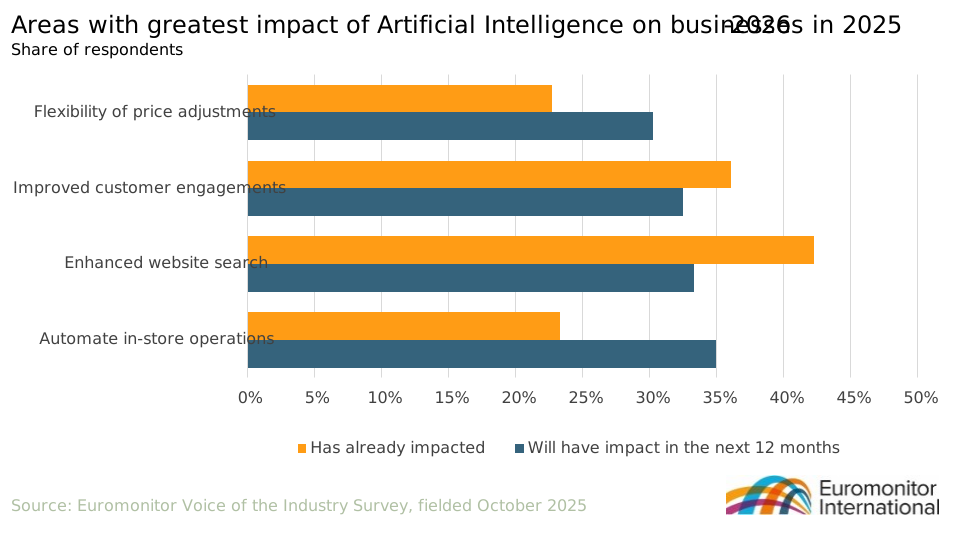
But the more consequential shift is AI’s role in external visibility. GenAI platforms are becoming a new channel for product discovery, with AI-driven referrals to e-commerce sites surging 304% in 2025, compared with 40% growth from all other referral sources combined.
In 2026, retailers know they must invest in AI, but to operationalise it at scale and adapt to an evolving discovery engine is becoming no easy feat.
The strategic question retail leaders must answer
Today, the competitive strategy in retail is not simply a question of technology investment or a channel prioritisation, but requires a deeper view into the shift in the conditions for remaining viable and in the capabilities retailers now need to compete.
The key challenge for retail leaders is no longer just how to grow, but how to remain discoverable, preferred, and profitable in systems they do not fully control. The retailers that succeed will share a distinct set of strategic capabilities, which we outline in our 5-vector strategy reset.
Read our report, Competitor Strategies in Retail, for understanding of five focus areas retailers must prioritise in 2026.