AI is moving from a supporting role to a system-level driver of FMCG innovation. As companies shift from high-volume launches to precision-led strategies, AI is enabling faster demand detection, more resilient formulation and new routes to visibility on the algorithmic shelf. This article explores how AI is redefining innovation advantage and why leading companies are embedding it as the engine of their innovation systems.
Half of FMCG companies already feel the impact of AI on innovation, and nearly 60% expect it to drive major change within the next five years.
Source: Euromonitor Voice of the Industry Survey, fielded October 2025 (n=170)
This is not just a technology shift. AI is becoming a catalyst for next-generation innovation strategy, reshaping how companies identify opportunity, design products, and compete for growth. This is unfolding alongside a broader reset in FMCG innovation as rising cost volatility, supply disruption, and tighter retailer scrutiny push companies away from high-volume, low-impact product development. Rapid advances in digital and AI technologies are also accelerating how demand evolves and how products are discovered. Hence, innovation is becoming more precise: companies are launching fewer products, with greater focus on scalability, resilience and value, using AI to reduce uncertainty, improve demand visibility, and validate what is most likely to succeed.
From tools to operating systems
How AI is applied within organisations is also changing. While AI in FMCG has been deployed as a series of point solutions, supporting different parts of the innovation process, leading companies are moving beyond this model, embedding AI as an always-on innovation system, enabling them to detect emerging demand signals earlier, model feasibility under changing cost and supply conditions, and validate concepts continuously rather than sequentially. This marks a shift away from traditional stage-gate models towards faster, feedback-driven cycles. Hence, a clear divide is emerging between organisations building AI-native innovation capabilities and those treating AI as an add-on.
Where AI is reshaping competitive advantage
Three areas stand out. First, formulation is becoming faster and more resilient. AI enables teams to simulate, test and refine concepts earlier in the process, reducing risk while increasing speed. In a context of climate volatility and ingredient disruption, the ability to model feasibility upfront is becoming a core competitive differentiator. Ingredients company Cargill is embedding AI-enabled formulation and ingredient tools to help its FMCG customers reformulate faster and adapt to shifting cost, supply, and clean label pressures.
Second, demand detection is shifting from products to intent. GenAI is changing how consumers search, with queries increasingly framed around problems rather than categories. This allows companies to identify unmet needs earlier and align innovation pipelines more precisely to emerging demand. For example, L’Oréal’s AI‑enabled Beauty Tech model helped detect early shifts in consumer intent, identifying the move from anti-ageing to longevity and guiding its innovation focus.
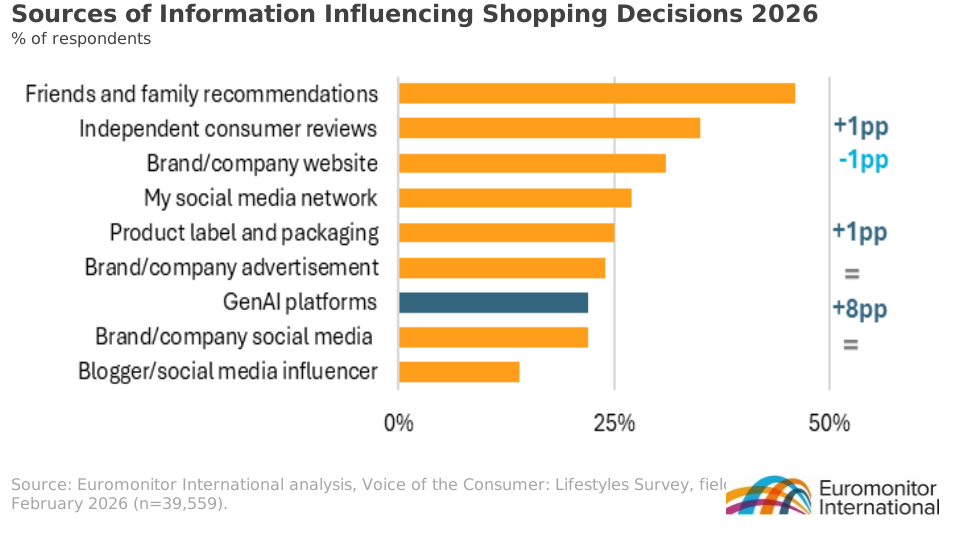
Third, AI is changing how people find products. More shopping decisions now happen through AI tools and digital platforms, where algorithms decide which brands get seen. In 2026, 22% of consumers used GenAI platforms to guide purchase decisions – an 8pp increase from 2025. This means success depends less on packaging and more on how clearly a product explains what it does. Brands that are easy for AI to understand will be easier for consumers to find.
Designing for two audiences
These shifts are creating a new design challenge. Innovation must now satisfy both human consumers and AI systems. Human decision-making remains driven by emotion, experience, and brand storytelling. By contrast, AI systems prioritise structured, factual, and outcome-led information. Products must therefore be designed to perform across both dimensions. Leading companies are responding by embedding AI-readiness into product design from the outset, ensuring claims, copy and metadata maximise both consumer appeal and machine interpretation. Those that retrofit this capability at launch are already falling behind.
The next phase: AI as the engine of innovation
AI-ready innovation is rapidly becoming the baseline. However, leading players are moving further, positioning AI as the engine of innovation itself. This means embedding AI across the entire system: shaping where to focus, determining what to develop, validating what will scale, and influencing what gets seen and chosen.
The implication is clear. The competitive advantage in FMCG innovation is shifting from isolated capabilities to integrated, AI-driven systems. Companies that act on this shift now will not simply accelerate innovation, they will define the structure and pace of the next innovation cycle.
Learn more in our full Competitor Strategies in Innovation briefing.